Structural CAD
I developed structural CAD for the rocket and reviewed how the nose cone, body tube, fin assembly, avionics bay, motor region, and recovery hardware fit together.
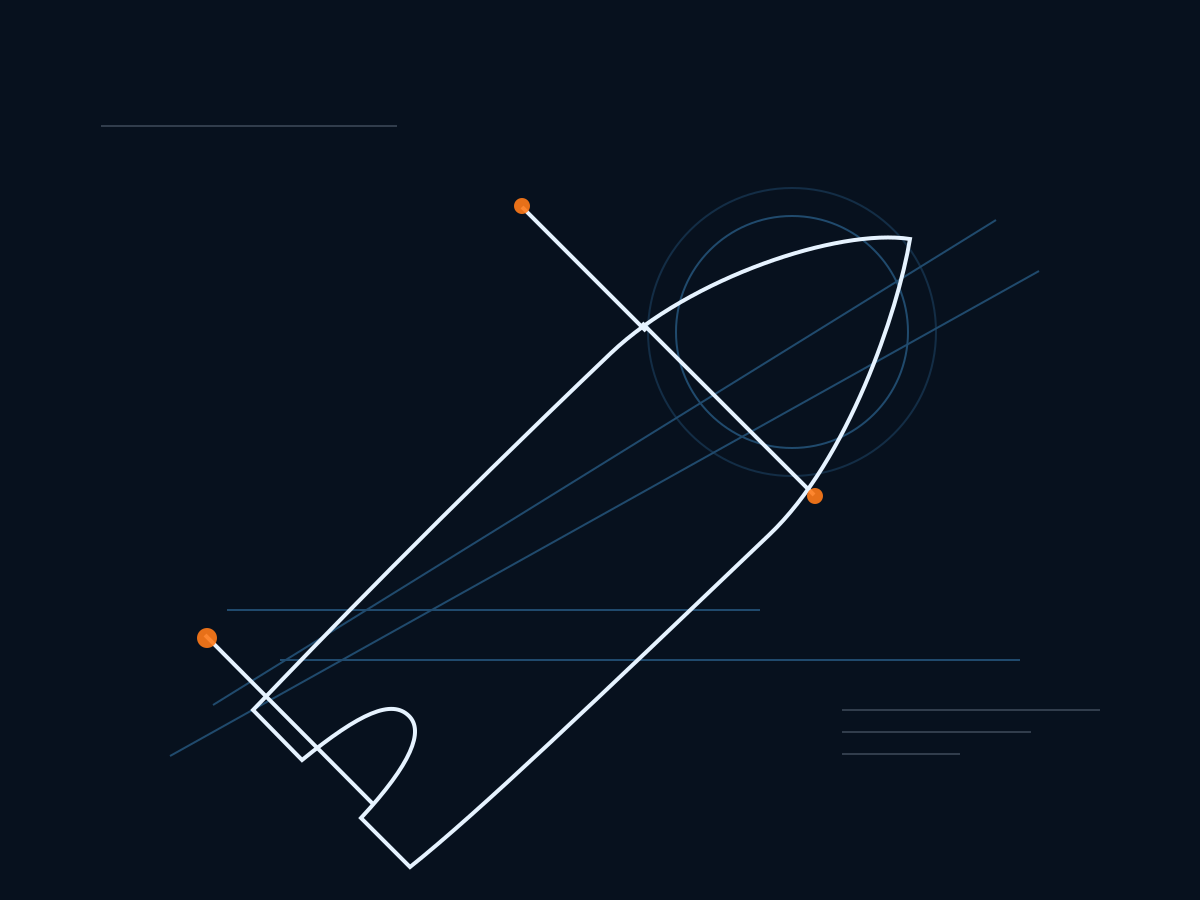
Structural design and simulation for a student rocket targeting a simulated 4,000-foot apogee
I led structural design work for Project Daedalus, including CAD development, component interfaces, manufacturing constraints, tolerance checks, and early simulation. I also worked with the avionics and propulsion teams to keep the rocket mechanically integrated as the design changed.
Project Daedalus challenged our team to design a compact rocket that could approach a simulated 4,000-foot apogee while remaining stable, manufacturable, and recoverable. The structure could not be designed independently from the rest of the vehicle.
Changes to the nose cone, fins, avionics packaging, motor placement, or recovery hardware affected total mass, center of gravity, center of pressure, drag, assembly, and deployment. I worked primarily on the mechanical and structural side: structural CAD, component interfaces, manufacturing considerations, tolerance checks, and early simulation.
I also communicated closely with teammates working on avionics and propulsion so their hardware could fit inside the vehicle and remain accessible during assembly.
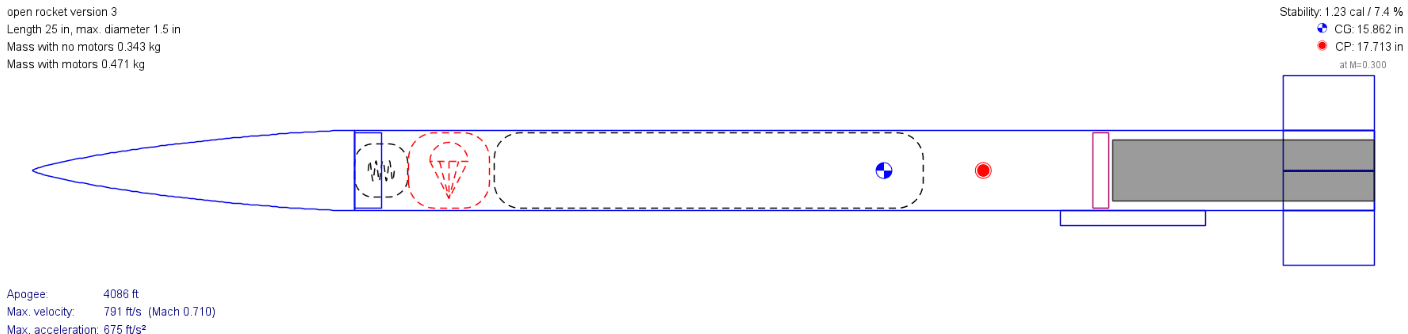
I developed structural CAD for the rocket and reviewed how the nose cone, body tube, fin assembly, avionics bay, motor region, and recovery hardware fit together.
I worked on the nose-cone geometry and its interface with the body tube. The part needed to support the aerodynamic profile, fit the available 3D printer, maintain adequate stiffness, and separate during parachute deployment.
I considered printer limits, material selection, wall geometry, infill, component clearances, and friction-fit behavior before fabrication. Small dimensional errors could prevent assembly or interfere with recovery deployment.
I worked with teammates responsible for avionics and propulsion to understand packaging, mounting, access, and wiring requirements. That communication helped keep mechanical changes from creating problems for another subsystem.
The nose cone had several jobs at once. It defined the leading aerodynamic geometry, added structural mass near the front of the vehicle, connected to the body tube, and separated as part of the recovery sequence.
The Von Kármán profile gave the team a practical aerodynamic shape for the available length and diameter. The design also had to fit within the available printer volume and avoid geometry that created unnecessary printing difficulty.
Using a high infill increased rigidity, but it also increased forward mass. That mass affected the vehicle's center of gravity, which meant the nose-cone design had to be evaluated in the context of the complete OpenRocket model.
The shoulder used a friction-fit connection with the body tube. The fit needed to remain secure during handling and ascent while still allowing the recovery system to separate the nose cone near apogee.
The complete vehicle mattered because each subsystem created structural interfaces. I did not own every subsystem, but their packaging and load paths affected the mechanical design.
The propulsion, recovery, and avionics systems are included to show the interfaces and constraints that affected my structural work. They were collaborative team systems rather than solely my individual designs.
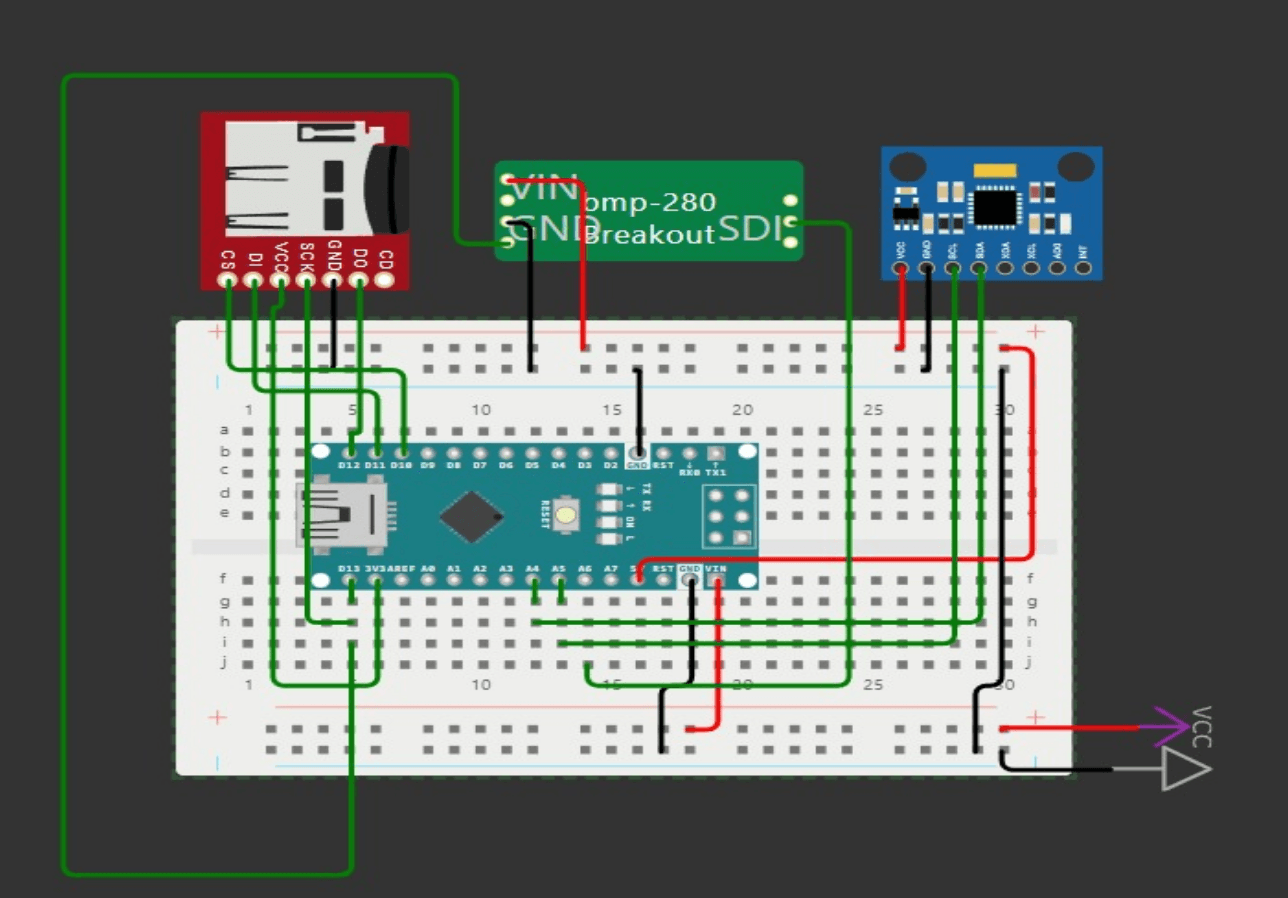
The avionics package affected the mechanical design even though my primary role was structural. The Arduino, pressure sensor, inertial sensor, SD-card module, battery, wiring, and mounting hardware all had to fit within the available internal diameter.
Mechanical design decisions had to preserve enough room for wiring, sensor placement, assembly, and removal. I regularly communicated with the electrical team to understand what space they needed and where mechanical access mattered.
The external geometry influenced drag, but the part still had to fit the available printer, print reliably, and connect to the body tube without excessive post-processing.
Increasing material, infill, or thickness improved rigidity but also changed total vehicle mass and shifted the center of gravity.
The nose-cone interface needed enough friction to remain assembled before deployment without preventing the recovery system from separating it.
Moving the motor, avionics, battery, recovery hardware, or printed components changed the mass distribution. Packaging choices therefore affected both mechanical integration and aerodynamic stability.
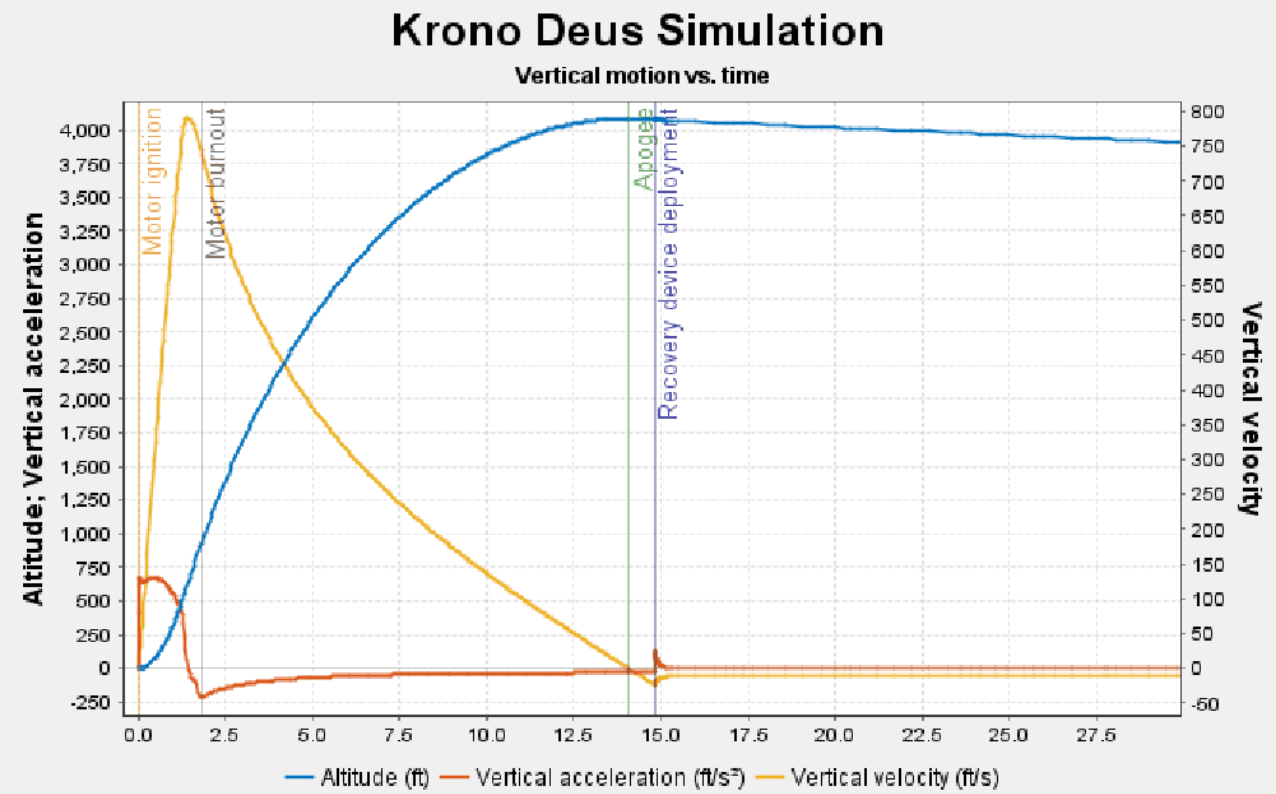
OpenRocket allowed the team to see how structural changes affected the complete flight model. A change that improved one component could also shift the center of gravity, change stability, add drag, or reduce predicted altitude.
I used these results as design guidance rather than treating the simulation as a substitute for physical validation. The model helped identify weak concepts and compare alternatives before fabrication.
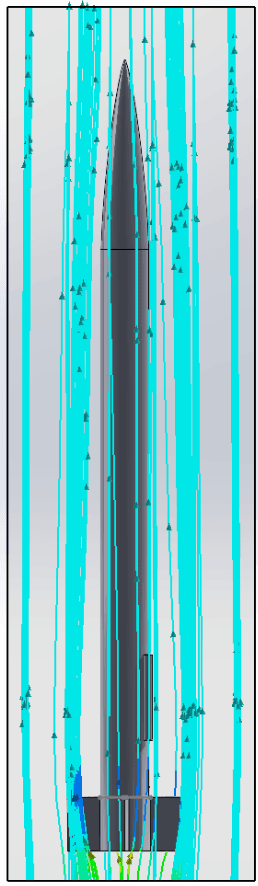
The flow simulation gave the team an early qualitative view of the pressure field and flow paths around the rocket geometry. It helped us identify areas of the vehicle worth examining and communicate how the external geometry interacted with the surrounding flow.
I treat this as an exploratory design study, not validated computational fluid dynamics. The project records I have do not document enough about the mesh, boundary conditions, turbulence model, convergence, or experimental correlation to claim more than that.
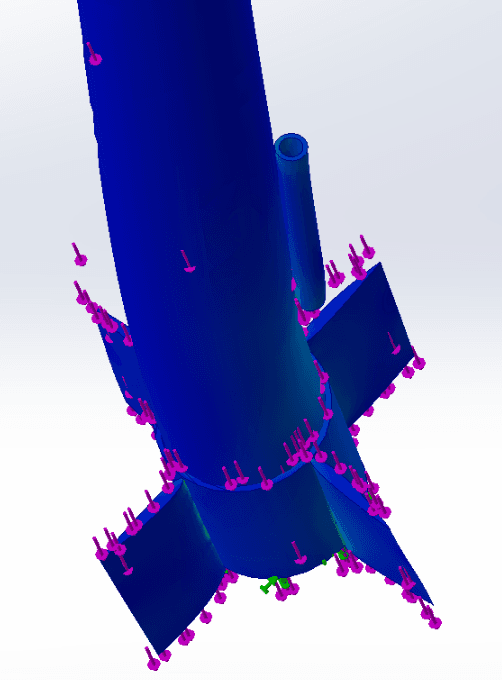
The structural simulations were used as preliminary design checks rather than formal qualification. They provided a way to inspect where deformation, strain, and stress concentrated under the modeled load before the team committed to fabrication.
The documented loading case applied approximately 39.25 lb to the modeled structure. The visual results helped the team review the body and fin region for concerning behavior and identify geometry that deserved closer attention.
Defined the approximate altitude target, vehicle envelope, stability needs, recovery approach, motor constraints, and manufacturing limits.
Created and reviewed early CAD for the nose cone, body structure, fins, avionics bay, and subsystem interfaces.
Used OpenRocket and preliminary structural studies to review stability, predicted performance, and structural behavior.
Coordinated with propulsion and avionics teammates as their packaging and hardware requirements developed.
Adjusted geometry, fit, material use, and component placement based on integration and manufacturing constraints.
Supported fabrication planning, physical assembly, and team testing activities.
This project changed how I think about mechanical design. A part can look correct in isolation and still cause problems when tolerances, manufacturing limits, wiring, mass distribution, recovery motion, and neighboring subsystems become real.
I learned to check interfaces earlier, use simulation to eliminate weak concepts before fabrication, and evaluate structural decisions in the context of the complete vehicle.
Working with teammates focused on avionics and propulsion also improved how I communicate across disciplines. I needed enough understanding of their systems to design around packaging, access, wiring, mounting, and deployment requirements.
Project Daedalus taught me to connect CAD, simulation, manufacturing, and subsystem communication. My strongest contribution was not a single isolated component. It was making structural decisions while accounting for how the complete rocket needed to assemble, remain stable, package its hardware, and support recovery.